Ever looked up at a hazy skyline and wondered what exactly you’re breathing in? Or heard about CFCs damaging the ozone layer and thought—what category does that even fall under?
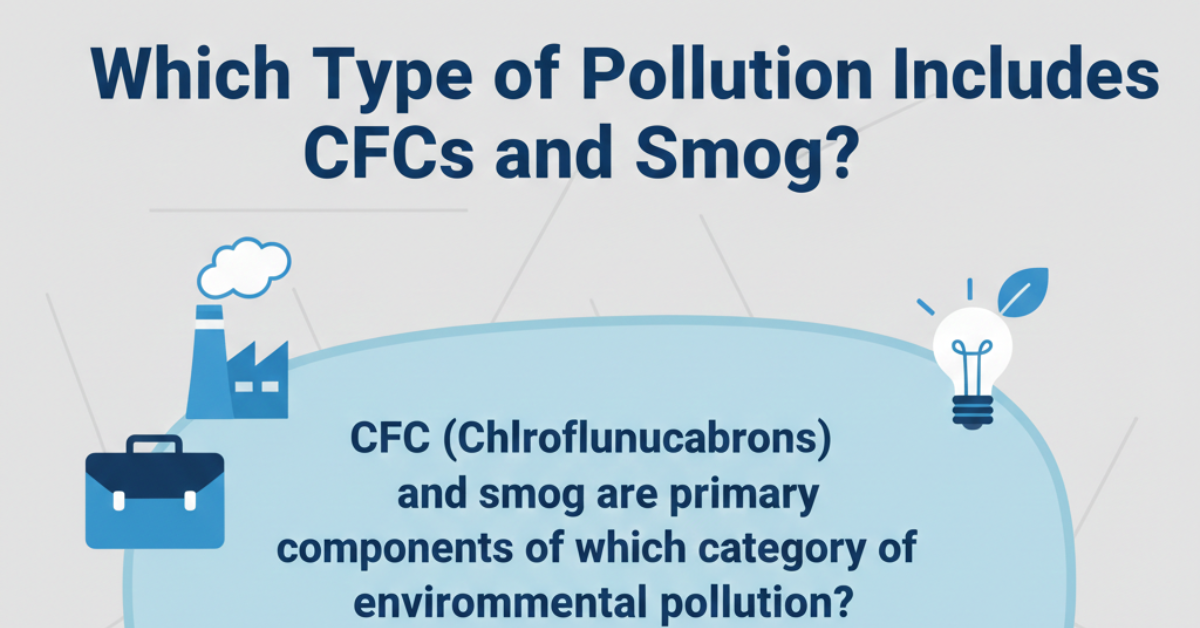
Let’s answer the big question clearly: which type of pollution includes CFCs and smog?
The answer is air pollution.
Both chlorofluorocarbons (CFCs) and smog are forms of air pollution, though they affect the atmosphere in different ways. In this guide, we’ll break it down in simple terms—what they are, how they form, why they matter, and what can be done about them.
What Is Air Pollution?
Air pollution refers to the presence of harmful substances in the atmosphere. These pollutants can be:
-
Gases (like carbon monoxide, sulfur dioxide, CFCs)
-
Particles (dust, smoke, soot)
-
Chemical compounds formed through reactions in the air (like smog)
Air pollution can be natural (volcanic eruptions, wildfires) or human-made (vehicle emissions, factories, aerosol sprays).
When asking which type of pollution includes CFCs and smog, we’re specifically talking about atmospheric or air pollution caused largely by human activity.
What Are CFCs? (Chlorofluorocarbons)
CFCs (chlorofluorocarbons) are synthetic chemical compounds once widely used in:
-
Refrigerators and air conditioners
-
Aerosol spray cans
-
Foam insulation products
-
Cleaning solvents
For decades, CFCs were considered miracle chemicals because they were stable and non-flammable. But that stability turned out to be the problem.
Why Are CFCs Dangerous?
CFCs rise into the upper atmosphere and break down under ultraviolet (UV) radiation. This releases chlorine atoms that destroy ozone molecules.
The result?
-
Ozone layer depletion
-
Increased UV radiation reaching Earth
-
Higher risks of skin cancer and cataracts
-
Damage to crops and marine ecosystems
The global response came through the Montreal Protocol, an international treaty signed in 1987 to phase out ozone-depleting substances. It’s widely considered one of the most successful environmental agreements ever.
So yes—CFCs are clearly a form of air pollution, specifically contributing to atmospheric and ozone pollution.
What Is Smog?
Smog is a visible type of air pollution that forms when pollutants react in sunlight.
The word “smog” originally came from combining smoke + fog.
There are two main types:
1. Industrial (Sulfurous) Smog
-
Caused by burning coal
-
Contains sulfur dioxide and particulates
-
Common during the Industrial Revolution
A tragic example is the Great Smog of London, which caused thousands of deaths due to severe air pollution.
2. Photochemical Smog
-
Common in sunny cities with heavy traffic
-
Formed when nitrogen oxides (NOx) and volatile organic compounds (VOCs) react in sunlight
-
Produces ground-level ozone
Cities like Los Angeles have historically struggled with photochemical smog due to traffic congestion and geographic conditions.
Smog causes:
-
Breathing difficulties
-
Eye irritation
-
Asthma attacks
-
Reduced visibility
-
Environmental damage
Again, this answers the question: which type of pollution includes CFCs and smog? Both are categorized under air pollution.
How CFCs and Smog Differ (But Share the Same Category)
While both fall under air pollution, they behave differently:
| Feature | CFCs | Smog |
| Type | Chemical compound | Mixture of pollutants |
| Visibility | Invisible | Visible haze |
| Main Impact | Ozone depletion | Respiratory health issues |
| Location of Impact | Upper atmosphere | Ground level |
Despite their differences, both contaminate the air and threaten environmental and human health.
Why Air Pollution Is a Serious Global Issue
Air pollution isn’t just an environmental problem—it’s a public health crisis.
According to the World Health Organization, millions of premature deaths each year are linked to air pollution exposure.
Long-term exposure can cause:
-
Lung disease
-
Heart disease
-
Stroke
-
Reduced life expectancy
CFCs also contribute indirectly to climate change, while smog worsens urban living conditions.
How We’ve Fought Back Against Air Pollution
Progress has been made—but it required global cooperation and policy change.
Key Actions Taken:
-
Banning CFC production under the Montreal Protocol
-
Cleaner vehicle emission standards
-
Transition to renewable energy
-
Air quality monitoring systems
-
Public awareness campaigns
Countries now regulate ozone-depleting substances and industrial emissions more strictly than ever before.
Frequently Asked Questions (FAQs)
Which type of pollution includes CFCs and smog?
Both CFCs and smog are forms of air pollution. CFCs damage the ozone layer, while smog affects ground-level air quality and human health.
Are CFCs still used today?
Most countries have phased out CFCs under international agreements, though some older equipment may still contain them.
Is smog the same as ozone depletion?
No. Smog forms near ground level and affects breathing. Ozone depletion occurs in the upper atmosphere due to chemicals like CFCs.
Can air pollution be reversed?
Yes, to some extent. The ozone layer is slowly recovering thanks to global CFC bans, showing that coordinated action works.
What causes photochemical smog?
It forms when vehicle emissions (NOx and VOCs) react with sunlight, producing harmful ground-level ozone.
Conclusion: The Clear Answer
If you’ve been wondering which type of pollution includes CFCs and smog?, the answer is straightforward: air pollution.
CFCs attack the ozone layer high above us. Smog chokes the air we breathe at street level. Different mechanisms—same category.
Here’s the bigger takeaway: air pollution isn’t abstract. It affects health, climate, and ecosystems. The good news? We’ve already proven that smart regulation and global cooperation can make a difference.