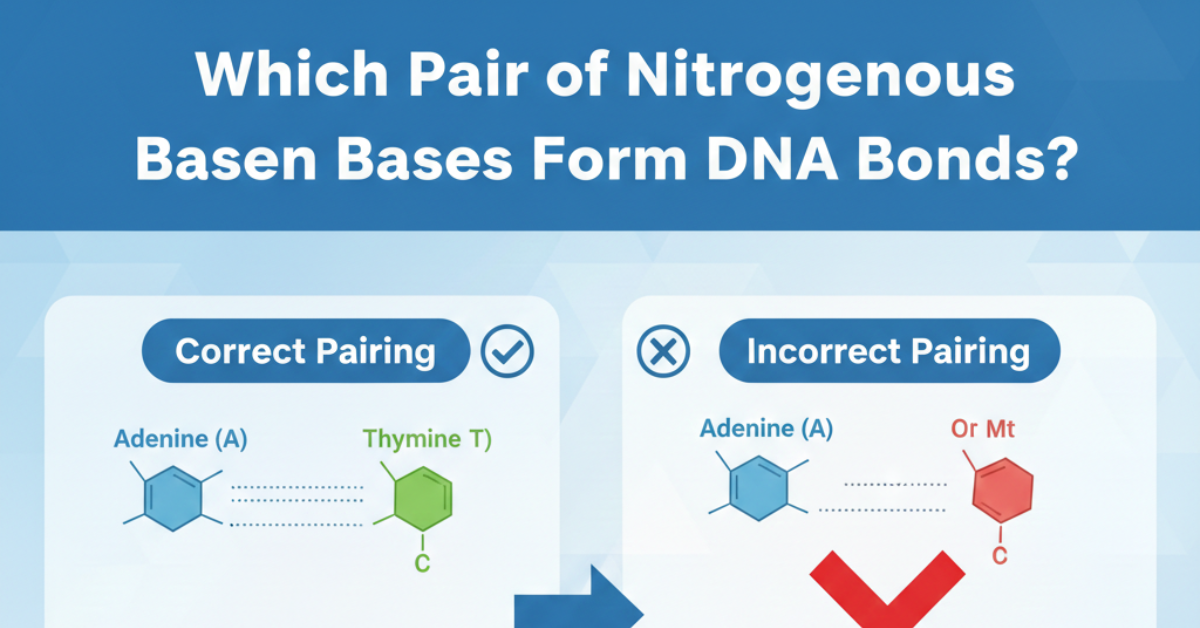
DNA is the blueprint of life, carrying the instructions for everything from your eye color to how your cells function. But have you ever wondered which pair of nitrogenous bases will form a bond in a DNA molecule and why this pairing is so precise? Understanding base pairing is crucial to unlocking the secrets of genetics, heredity, and molecular biology.
In this article, we’ll break it down in simple terms, explore the science behind DNA’s structure, and answer common questions about nitrogenous bases and their bonds.
Understanding Nitrogenous Bases in DNA
DNA is made up of smaller units called nucleotides. Each nucleotide consists of three components:
-
A sugar molecule (deoxyribose)
-
A phosphate group
-
A nitrogenous base
The nitrogenous bases are the star players here, and they come in four types:
-
Adenine (A)
-
Thymine (T)
-
Cytosine (C)
-
Guanine (G)
These bases form specific pairs through hydrogen bonds, which hold the two DNA strands together like rungs on a ladder.
The Base Pairing Rule
The question “which pair of nitrogenous bases will form a bond in a DNA molecule” has a precise answer thanks to the Watson-Crick base pairing rules:
-
Adenine (A) pairs with Thymine (T) – connected by two hydrogen bonds
-
Cytosine (C) pairs with Guanine (G) – connected by three hydrogen bonds
This complementary pairing ensures DNA is stable and can replicate accurately during cell division.
Why this pairing matters:
-
Maintains the double helix structure
-
Ensures genetic information is copied correctly
-
Allows DNA to be “read” for protein synthesis
How Hydrogen Bonds Work in DNA
Hydrogen bonds are weak individually but strong collectively. Here’s a quick breakdown:
-
A-T bonds: 2 hydrogen bonds → slightly easier to separate
-
C-G bonds: 3 hydrogen bonds → stronger, more stable
The number of C-G pairs can influence the DNA’s melting temperature, which is important in labs when analyzing DNA through techniques like PCR.
Common Misconceptions About Base Pairing
Many people assume that any base can pair with another, but that’s not true. Key facts:
-
Adenine never pairs with Guanine
-
Cytosine never pairs with Thymine
-
Pairing is determined by the shape and hydrogen bonding capacity of the bases
Keeping this in mind helps avoid confusion in genetics studies.
Real-Life Importance of Nitrogenous Base Pairing
Understanding which pair of nitrogenous bases will form a bond in a DNA molecule isn’t just academic; it’s crucial in fields like:
-
Genetic testing – Detect mutations or hereditary conditions
-
Forensic science – DNA fingerprinting
-
Biotechnology – Gene editing and cloning
-
Medical research – Studying diseases at a molecular level
FAQs About DNA Base Pairing
Q1: Can adenine pair with cytosine?
No, adenine only pairs with thymine due to hydrogen bonding and molecular structure.
Q2: How many hydrogen bonds hold DNA together?
A-T pairs have 2 hydrogen bonds; C-G pairs have 3 hydrogen bonds.
Q3: Why does C-G pairing make DNA more stable?
More hydrogen bonds make C-G-rich DNA regions harder to separate, increasing stability.
Q4: Can DNA bases pair with RNA bases?
Yes, but in RNA, uracil (U) replaces thymine. Adenine pairs with uracil in RNA.
Q5: Who discovered base pairing rules?
James Watson and Francis Crick, with contributions from Rosalind Franklin and Erwin Chargaff.
Conclusion
In summary, the correct answer to which pair of nitrogenous bases will form a bond in a DNA molecule is:
-
Adenine with Thymine (A-T)
-
Cytosine with Guanine (C-G)
This simple rule ensures the integrity of DNA, allowing life to flourish with consistent genetic information. By understanding these base pairs, you’re unlocking the fundamental language of genetics.