What actually happens when an economy slows down? The short answer: people and businesses spend less, companies cut production, and the slowdown feeds on itself. If you’ve ever wondered which best describes how a recession develops as demand and production decrease, this guide breaks it down in plain language.
A recession doesn’t appear overnight. It builds through a chain reaction—falling demand leads to reduced output, job losses, lower income, and even weaker demand. Understanding this cycle helps make sense of economic news, business trends, and job market changes.
The Core Mechanism: The Demand–Production Spiral
The best description of how a recession develops is:
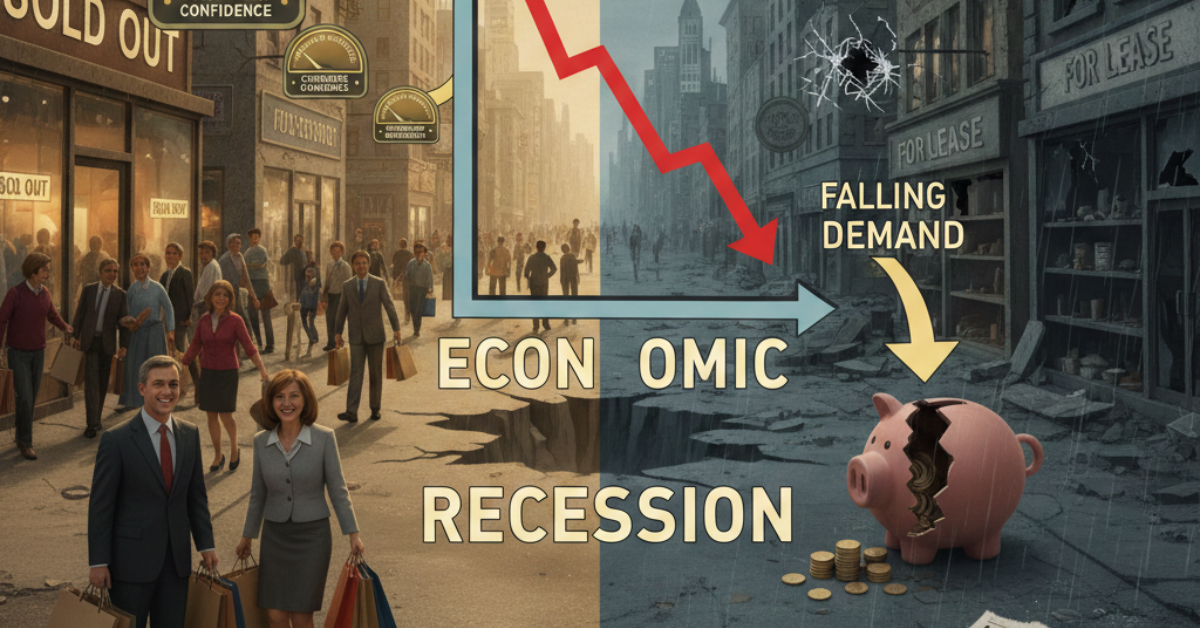
When consumer and business demand falls, companies reduce production. This leads to layoffs and lower incomes, which further reduce spending, creating a downward economic cycle.
Economists call this a negative feedback loop or contraction cycle.
Here’s the simplified flow:
-
Demand drops (people buy less)
-
Businesses cut production
-
Workers lose hours or jobs
-
Household income falls
-
Spending declines further
-
The cycle repeats
This is the classic pathway into a recession.
Why Demand Falls in the First Place
Demand doesn’t just collapse randomly. Several triggers can start the process:
H3: Common Causes of Falling Demand
-
Rising interest rates (loans become expensive)
-
High inflation (purchasing power drops)
-
Stock market or housing declines
-
Economic uncertainty or fear
-
Global shocks (pandemics, wars, supply disruptions)
When consumers feel uncertain, they delay big purchases like homes, cars, or electronics. Businesses respond by slowing investment and hiring.
How Production Responds to Lower Demand
Companies closely watch sales. When orders fall, they act quickly to control costs.
Typical Business Reactions
-
Reduce factory output
-
Cut overtime or shifts
-
Freeze hiring
-
Lay off workers
-
Delay expansion plans
Lower production means fewer goods and services being created—one of the defining signs of a recession.
The Employment and Income Effect
This stage turns a slowdown into a broader economic contraction.
When businesses cut jobs:
-
Household income declines
-
Consumer confidence drops
-
Spending falls even more
This creates what economists call the multiplier effect—one job loss affects many other businesses (retail, restaurants, services).
The Negative Multiplier Cycle Explained
A recession deepens because each reduction spreads through the economy.
Example:
-
A factory cuts 100 workers
-
Those workers reduce spending
-
Local stores lose sales
-
Stores cut staff
-
The slowdown spreads regionally
This is the clearest answer to which best describes how a recession develops as demand and production decrease: declining demand triggers a chain reaction that reinforces economic contraction.
Key Economic Indicators During a Recession
As the cycle unfolds, several warning signs appear:
-
Falling GDP (Gross Domestic Product)
-
Rising unemployment
-
Declining industrial production
-
Lower consumer spending
-
Reduced business investment
-
Weak retail and housing markets
Economists typically define a recession as two consecutive quarters of negative GDP growth, though broader indicators also matter.
Real-World Example of the Demand–Production Cycle
During the 2008 financial crisis:
-
Housing prices collapsed
-
Consumers cut spending
-
Businesses reduced output
-
Unemployment surged
-
Demand fell further
The same pattern appeared globally during the early stages of the COVID-19 economic shutdown.
How Governments and Central Banks Respond
To break the cycle, policymakers try to boost demand.
Common Economic Stimulus Tools
-
Lower interest rates
-
Government spending programs
-
Tax cuts or rebates
-
Unemployment benefits
-
Business support loans
The goal is simple: put money back into the economy so demand and production recover.
FAQs
1. What is the simplest explanation of a recession?
A recession happens when spending falls, businesses produce less, jobs are lost, and the economy shrinks for an extended period.
2. Does lower demand always cause a recession?
Not always. A small decline may slow growth, but a widespread and prolonged drop in demand can trigger a recession.
3. How long do recessions usually last?
Most recessions last between 6 and 18 months, though recovery speed varies.
4. Who is most affected during a recession?
Workers in cyclical industries (manufacturing, construction, retail) and small businesses often feel the impact first.
5. Can recessions be prevented?
They can’t always be prevented, but early policy actions can reduce their severity and duration.
Conclusion
So, which best describes how a recession develops as demand and production decrease? It’s a self-reinforcing cycle: falling demand leads to lower production, job losses reduce income, and weaker spending pushes the economy deeper into contraction.
Understanding this chain reaction helps you interpret economic trends, make smarter financial decisions, and stay prepared during uncertain times.