
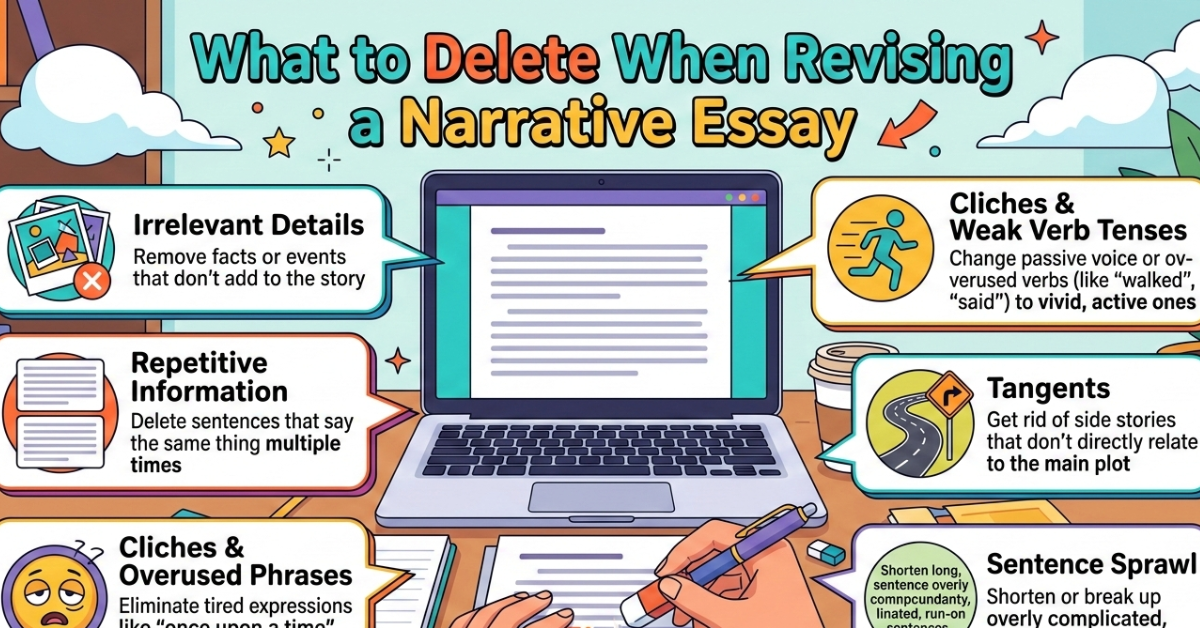
Revision is where good writing becomes powerful writing. If you’re wondering during the revision process, which type of wording should a writer delete in a narrative essay, the answer is simple: anything that slows the story down, weakens the voice, or distracts from the main experience.
Narrative essays work best when they feel clear, vivid, and purposeful. That means cutting clutter, tightening language, and keeping only the words that move the story forward. In this guide, you’ll learn exactly what to remove—and why—so your narrative becomes sharper, stronger, and more engaging.
Why Deleting Words Improves Narrative Writing
Strong narratives rely on momentum and emotional impact. Extra or weak wording can:
-
Break the flow of the story
-
Make scenes feel dull or repetitive
-
Reduce emotional impact
-
Confuse the reader
Good revision isn’t about adding more—it’s about removing what doesn’t serve the story.
1. Delete Filler Words and Empty Phrases
One of the first things to cut during revision is unnecessary filler. These words add length but no real meaning.
Common filler words to remove
-
very
-
really
-
just
-
basically
-
actually
-
kind of / sort of
-
in order to
Example:
-
Weak: I was very, very nervous before the speech.
-
Strong: I was nervous before the speech.
Tip: If the sentence still makes sense without the word, delete it.
2. Remove Repetition
Repetition is one of the biggest problems in narrative essays. Saying the same idea multiple times weakens your impact.
Watch for:
-
Repeating emotions (“I was scared” several times)
-
Restating events unnecessarily
-
Explaining what the reader already understands
Example:
-
Weak: I was terrified. I felt really scared and afraid.
-
Strong: I was terrified.
Instead of repeating, show the emotion through action or detail.
3. Cut Weak or Vague Language
Narratives should be vivid. Vague wording makes scenes feel flat.
Words to delete or replace
-
things
-
stuff
-
a lot
-
very big/small
-
something
Example:
-
Weak: There were a lot of things happening.
-
Strong: People shouted, phones rang, and doors slammed.
Replace vague words with specific sensory details.
4. Eliminate Redundant Phrases
Redundancy happens when words repeat the same meaning.
Examples to revise
-
I thought to myself → I thought
-
past history → history
-
each and every → each
-
completely finished → finished
These small cuts make your writing cleaner and more professional.
5. Delete Unnecessary Dialogue Tags and Stage Directions
Narrative essays often include dialogue, but overloading it with tags slows the story.
What to cut:
-
he said loudly (if the dialogue already shows emotion)
-
Excessive action tags after every line
Example:
-
Weak: “Stop!” she shouted loudly in a loud voice.
-
Strong: “Stop!” she shouted.
Let the dialogue carry the emotion.
6. Remove Off-Topic Details
A strong narrative stays focused on one main experience or lesson. During revision, ask:
-
Does this detail move the story forward?
-
Does it support the theme or message?
If not, cut it—even if you like it.
Common distractions to delete
-
Long background explanations
-
Irrelevant descriptions
-
Side stories that don’t connect to the main event
Remember: Every sentence should serve the story’s purpose.
7. Replace Passive Voice and Weak Verbs
Passive or weak verbs drain energy from a narrative.
Example:
-
Weak: The ball was thrown by me.
-
Strong: I threw the ball.
Also replace weak verbs like:
-
went → rushed, walked, stumbled
-
made → built, created, prepared
Stronger verbs create more vivid storytelling.
Quick Revision Checklist for Narrative Essays
During the revision process, delete:
-
Filler words and empty phrases
-
Repetition
-
Vague language
-
Redundant expressions
-
Unnecessary dialogue tags
-
Off-topic details
-
Passive voice and weak verbs
If a word doesn’t add meaning, emotion, or clarity—cut it.
FAQs
What is the most important thing to remove during narrative revision?
Filler words and repetition. These are the most common issues that weaken narrative flow and clarity.
Should I delete descriptive details?
No—only remove details that don’t support the main event or theme. Keep sensory details that make the story vivid.
How do I know if a sentence should be deleted?
Ask: Does this move the story forward or deepen the reader’s understanding? If the answer is no, delete it.
Is shorter always better in a narrative essay?
Not necessarily. The goal is clear and purposeful writing, not just fewer words.
How many times should I revise a narrative essay?
At least two to three rounds: one for content, one for clarity, and one for grammar and style.
Conclusion
So, during the revision process, which type of wording should a writer delete in a narrative essay? The answer comes down to this: remove anything that weakens clarity, slows the story, or adds no value. Cut filler, repetition, vague language, and irrelevant details. Keep only the words that strengthen your message and bring your experience to life.
Strong narratives aren’t written—they’re rewritten. Take the time to trim your essay, and you’ll end up with a story that feels tighter, clearer, and far more powerful.