Understanding government processes doesn’t have to be complicated. If you’ve ever searched for how a bill becomes a law flowchart, you’re probably looking for a clear, visual way to see how ideas turn into official laws.
In this guide, we’ll break the process down into simple steps, explain each stage in plain language, and provide resources like a how a bill becomes a law flowchart PDF, worksheets, and answers to help students, teachers, and curious readers alike.
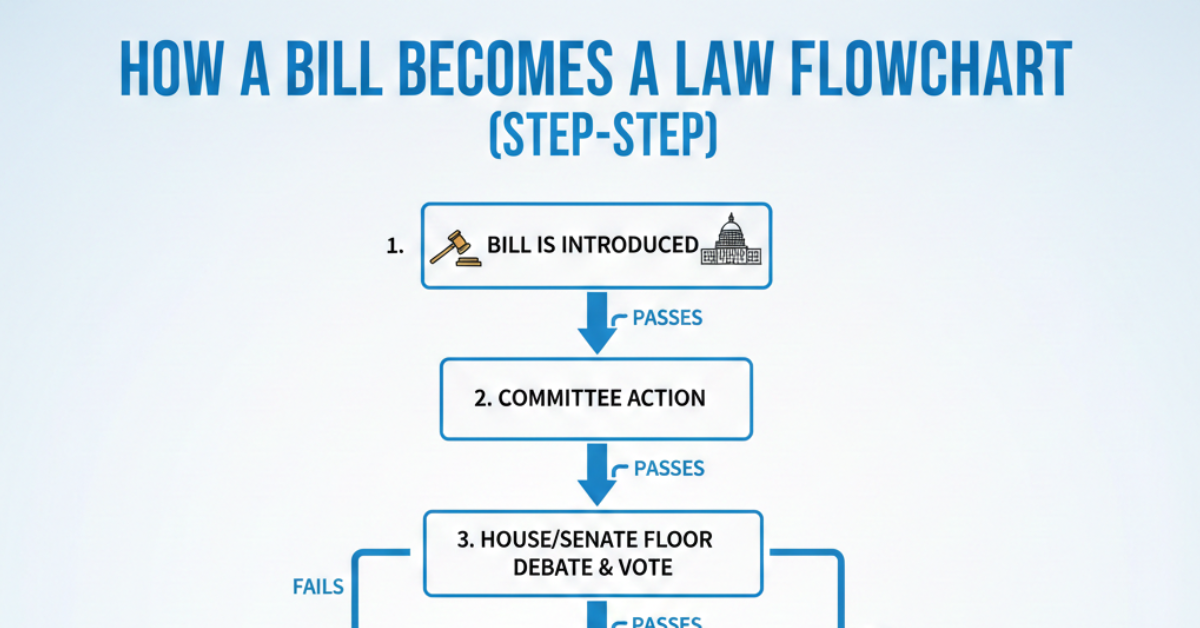
How a Bill Becomes a Law Flowchart (Simple Overview)
-
Idea for a Bill
-
Bill Introduced in Congress
-
Committee Review
-
Debate and Vote in First Chamber
-
Sent to Second Chamber
-
Second Chamber Debate and Vote
-
Conference Committee (if needed)
-
President’s Decision
-
Sign → Becomes law
-
Veto → Back to Congress
-
No action → May become law automatically
-
This is the structure most how a bill becomes a law flowchart worksheets are based on.
Step-by-Step Explanation of the Legislative Process
1. The Idea Stage
Every law starts as an idea. It might come from:
-
Citizens
-
Interest groups
-
Government officials
-
Members of Congress
If a legislator supports the idea, they turn it into a written proposal called a bill.
2. Bill Introduction in Congress
The bill is introduced in either:
-
The House of Representatives, or
-
The Senate
Once introduced, it receives a number and is officially entered into the legislative system.
LSI keywords: legislative process, bill introduction, Congress procedure.
3. Committee Review (Where Most Bills Stop)
The bill is sent to a specialized committee. Here, members:
-
Study the bill
-
Hold hearings
-
Suggest changes
-
Vote to approve or reject it
If the committee rejects the bill, it usually goes no further.
4. Debate and Vote in the First Chamber
If approved by committee:
-
The full House or Senate debates the bill
-
Members may amend it
-
A majority vote is required to pass
5. The Second Chamber Process
The bill then moves to the other chamber (House or Senate), where the same steps repeat:
-
Committee review
-
Debate
-
Vote
If changes are made, both chambers must agree on the final version.
6. Conference Committee (If Needed)
If the House and Senate pass different versions:
-
A conference committee resolves the differences
-
Both chambers vote again on the final version
This step often appears in detailed how a bill becomes a law flowchart answers for classroom assignments.
7. The President’s Decision
The final bill goes to the President, who can:
-
Sign it → It becomes law
-
Veto it → Returns to Congress
-
Take no action for 10 days
-
Congress in session → Becomes law
-
Congress adjourned → Pocket veto
-
Congress can override a veto with a two-thirds vote in both chambers.
How a Bill Becomes a Law Flowchart PDF & Worksheet
If you’re teaching or studying civics, here’s how to use resources effectively:
Flowchart PDF Uses
-
Classroom handouts
-
Study guides
-
Exam review materials
Worksheet Ideas
-
Fill-in-the-blank flowchart
-
Match steps to descriptions
-
Identify where a bill can fail
-
Short-answer questions
Common Worksheet Answers (Summary)
-
Idea
-
Introduced
-
Committee
-
Floor debate
-
Vote
-
Second chamber
-
Conference committee
-
President decision
Why the Flowchart Method Works
A how a bill becomes a law flowchart simple format helps because it:
-
Breaks complex government processes into steps
-
Improves memory and understanding
-
Helps visual learners
-
Makes exam preparation easier
-
Shows decision points (like veto or rejection)
For students, it’s often the fastest way to understand the legislative system.
FAQs: How a Bill Becomes a Law Flowchart
Q1: What is the easiest way to remember how a bill becomes a law?
Use a simple flowchart: Idea → Congress → Committee → Vote → Second chamber → President.
Q2: Where can I find a how a bill becomes a law flowchart PDF?
Educational websites, government portals, and classroom resource sites often provide free downloadable PDFs.
Q3: What is a pocket veto?
If the President takes no action and Congress adjourns within 10 days, the bill does not become law.
Q4: Can a bill become law without the President’s signature?
Yes. If the President does nothing for 10 days while Congress is in session, it automatically becomes law.
Q5: Why do worksheets ask for flowchart answers?
They test understanding of the sequence and decision points in the legislative process.
Conclusion
The how a bill becomes a law flowchart turns a complicated government process into a clear, logical sequence. From a simple idea to presidential approval, each step plays a critical role in shaping the laws that govern society.
If you’re studying civics or teaching others, download a flowchart PDF, practice with worksheets, and review the steps regularly. Visual learning makes the process stick—and once you understand the flow, the legislative system becomes far less intimidating.