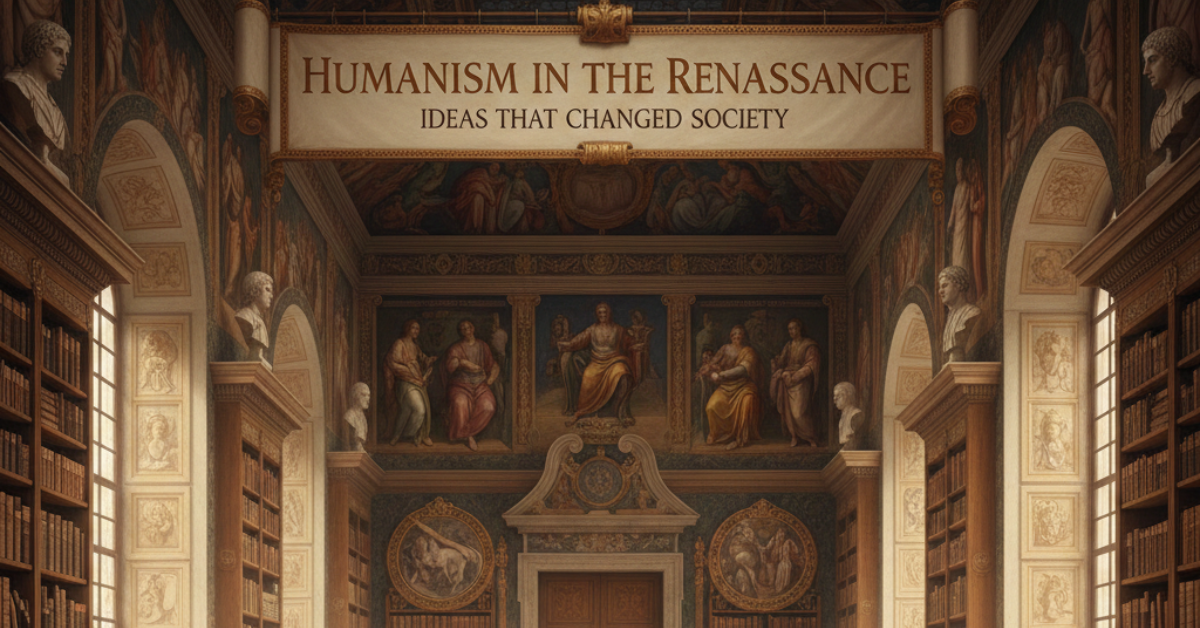
What if a single shift in thinking could transform art, education, politics, and everyday life? That’s exactly what happened during the Renaissance. The question many learners ask is: which humanist idea affected Renaissance society the most?
The answer lies in one powerful belief—human potential and individual worth matter. Renaissance humanism moved society away from a purely religious focus and toward a balanced view of human achievement, education, and creativity. This article breaks down the key humanist ideas that reshaped Renaissance society and explains why their influence still matters today.
What Was Renaissance Humanism?
-
The value of human life on Earth
-
Classical Greek and Roman knowledge
-
Critical thinking and education
-
Individual achievement
Scholars such as Francesco Petrarch and Desiderius Erasmus helped spread these ideas across Europe.
Target keyword focus: which humanist idea affected Renaissance society — the central idea was the belief in human dignity and potential.
The Core Humanist Idea That Shaped Renaissance Society
1. The Dignity and Potential of the Individual
The most influential humanist belief was simple but revolutionary:
Humans are capable of greatness and should develop their talents.
This idea changed society in several ways:
-
Art became realistic and focused on human beauty and emotion.
-
Artists like Leonardo da Vinci and Michelangelo studied anatomy and nature.
-
Portraits celebrated real individuals, not just religious figures.
Human life was no longer seen as something to endure—it became something to improve and celebrate.
Other Humanist Ideas That Influenced Society
2. Education for a Well-Rounded Life (Studia Humanitatis)
Humanists promoted a new curriculum called studia humanitatis, which included:
-
Grammar
-
Rhetoric
-
History
-
Poetry
-
Moral philosophy
The goal wasn’t job training—it was creating thoughtful, responsible citizens.
Impact:
-
Schools and universities expanded.
-
Education became important for leadership and public service.
-
Literacy and learning spread beyond the clergy.
3. Return to Classical Knowledge
Humanists believed ancient Greece and Rome held valuable wisdom.
How this changed society:
-
Classical architecture influenced buildings.
-
Writers modeled their work on Roman authors.
-
Political thinkers studied Roman government ideas.
This revival of classical culture gave the Renaissance its distinctive style and intellectual energy.
4. Civic Humanism: Active Citizenship
Humanism wasn’t just about personal growth—it encouraged participation in public life.
Key beliefs:
-
Educated citizens should serve their communities.
-
Government should promote the common good.
-
Leadership required education and moral character.
This idea was especially strong in city-states like Florence.
How Humanism Changed Everyday Renaissance Life
The humanist movement influenced multiple areas:
Art & Culture
-
Realistic paintings and sculptures
-
Focus on human emotion and experience
Politics
-
Educated leaders
-
Interest in republican government
Religion
-
More personal faith and critical study of religious texts
Science & Exploration
-
Curiosity about the natural world
-
Foundations for the Scientific Revolution
Why the Idea of Human Potential Was the Most Important
If you’re still asking which humanist idea affected Renaissance society the most, it comes down to this:
Belief in human ability unlocked creativity, learning, and innovation.
Once people believed they could improve the world—and themselves—the Renaissance became a period of rapid cultural and intellectual growth.
FAQs
1. What is the main idea of Renaissance humanism?
The main idea is that humans have dignity, value, and the ability to achieve great things through education and effort.
2. Which humanist idea had the biggest impact?
The belief in human potential and individual achievement had the greatest influence on Renaissance society.
3. How did humanism affect art?
Artists created realistic works, studied anatomy, and focused on human emotion and beauty.
4. Did humanism oppose religion?
No. Most humanists were religious but believed faith should be combined with education and critical thinking.
5. Where did humanism begin?
It began in Italy, especially in cities like Florence, before spreading across Europe.
Conclusion
The Renaissance wasn’t just a rebirth of art—it was a rebirth of confidence in human ability. The key answer to which humanist idea affected Renaissance society is the belief that individuals have worth, talent, and the power to shape their world.
That single idea transformed education, inspired artistic masterpieces, influenced politics, and laid the groundwork for modern thinking. If you want to go deeper, explore related topics like Renaissance art, civic humanism, or the Scientific Revolution to see how this mindset reshaped history.