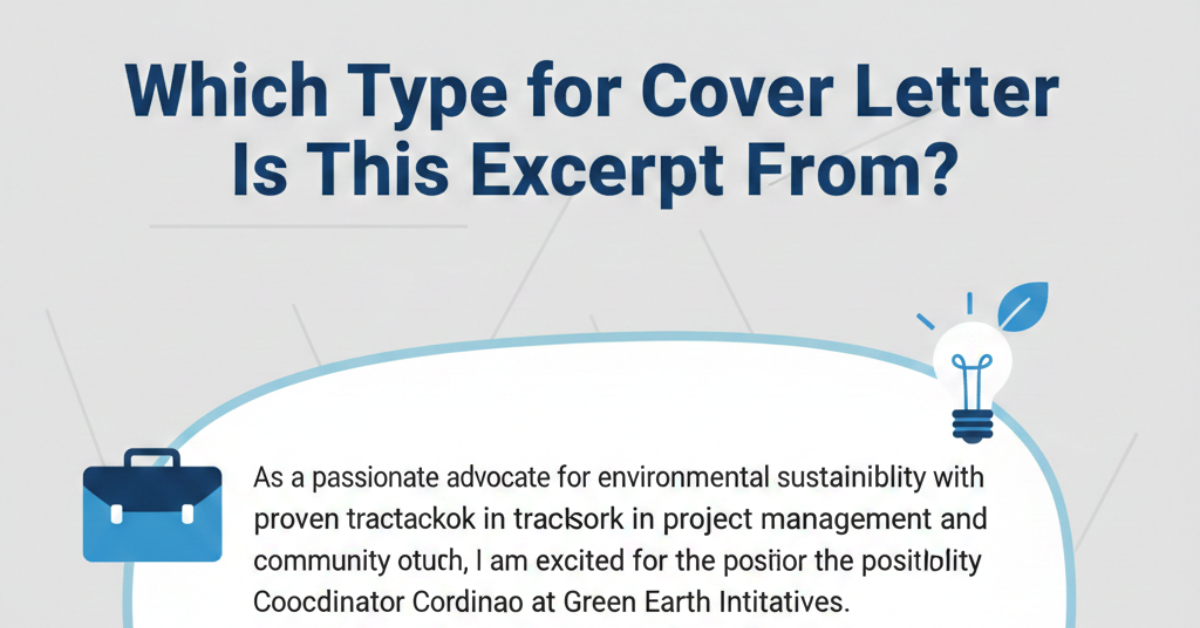
Ever read a paragraph from a cover letter and thought, Wait… what kind of cover letter is this?
If you’re trying to figure out which type of cover letter would the above excerpt come from, you’re not alone. This question shows up in job readiness courses, career exams, and interview prep materials all the time.
The truth is simple: there are four primary types of cover letters—prospecting, networking, application, and follow-up. Each one has a specific purpose, tone, and structure. Once you understand the differences, identifying the right type becomes easy.
Let’s break it down clearly and practically.
The Four Main Types of Cover Letters
Before answering which type of cover letter would the above excerpt come from?, you need to understand the core categories.
1. Application Cover Letter
This is the most common type.
An application cover letter is written in response to a specific job posting. It directly references the position and explains why the applicant is qualified.
Key Features:
-
Mentions the job title
-
Refers to where the job was posted
-
Highlights relevant experience
-
Connects skills to job requirements
Example Clue in an Excerpt:
“I am writing to apply for the Marketing Coordinator position listed on your company website.”
If the excerpt references a specific job opening, it’s almost always an application cover letter.
2. Prospecting Cover Letter
A prospecting cover letter (also called a letter of inquiry) is sent to companies that haven’t advertised an open position.
The goal? To ask about potential opportunities.
Key Features:
-
No specific job posting mentioned
-
Expresses interest in working for the company
-
Asks about possible openings
Example Clue in an Excerpt:
“I am very interested in exploring opportunities within your organization.”
If the excerpt focuses on interest in the company rather than a posted job, it likely comes from a prospecting cover letter.
3. Networking Cover Letter
A networking cover letter is written when someone refers you to a company or hiring manager.
This type leverages professional connections.
Key Features:
-
Mentions a referral
-
References a mutual contact
-
Often more conversational in tone
Example Clue in an Excerpt:
“John Smith suggested I contact you regarding potential roles in your department.”
If the excerpt mentions a referral or mutual connection, it’s a networking cover letter.
4. Follow-Up Cover Letter
A follow-up cover letter is sent after submitting an application or attending an interview.
Its purpose is to reinforce interest and keep communication open.
Key Features:
-
References a previous application or meeting
-
Expresses continued interest
-
Politely requests an update
Example Clue in an Excerpt:
“I wanted to follow up regarding my application submitted last month.”
If the excerpt refers to previous contact, it belongs to a follow-up cover letter.
How to Identify Which Type of Cover Letter the Excerpt Comes From
If you’re stuck on the question, here’s a quick framework:
Step 1: Look for a Job Posting Mention
-
Yes → Application cover letter
-
No → Move to Step 2
Step 2: Look for a Referral
-
Mentions a person → Networking cover letter
-
No referral → Move to Step 3
After 3: Look for Previous Contact
-
References earlier application or interview → Follow-up cover letter
-
No previous contact → Prospecting cover letter
Simple. Direct. No guesswork.
Comparison Table: Cover Letter Types at a Glance
| Type | Sent When | Main Goal | Mentions Job Posting? |
| Application | Job is advertised | Apply for specific role | Yes |
| Prospecting | No job posted | Ask about opportunities | No |
| Networking | Referred by someone | Leverage connection | Sometimes |
| Follow-Up | After applying/interviewing | Reinforce interest | Yes (previously) |
Why This Question Matters
Understanding which type of cover letter would the above excerpt come from? isn’t just an academic exercise.
It helps you:
-
Tailor your job application strategy
-
Avoid sending the wrong message
-
Write stronger, more focused cover letters
-
Pass job readiness exams and assessments
Recruiters can instantly tell if you’ve used the wrong format. That mistake costs interviews.
Common Mistakes When Identifying Cover Letter Types
Let’s clear up confusion.
Mistake 1: Assuming All Cover Letters Are Application Letters
They’re not. Many professionals use prospecting and networking letters strategically.
Mistake 2: Confusing Prospecting with Networking
If there’s no referral mentioned, it’s not networking.
Mistake 3: Overlooking Time References
Phrases like “as discussed last week” are strong signals of a follow-up cover letter.
Pay attention to context. That’s everything.
FAQs
1. Which type of cover letter is most common?
The application cover letter is the most common because it responds directly to job postings.
2. What is the difference between a prospecting and application cover letter?
An application cover letter responds to a specific job listing. A prospecting cover letter inquires about potential openings when no job is posted.
3. Can a cover letter include elements of more than one type?
Yes, but it should still have a primary purpose. For example, you can apply for a job and mention a referral—making it primarily an application cover letter with networking elements.
4. What if the excerpt doesn’t mention a job or referral?
It is most likely a prospecting cover letter.
5. Why do teachers ask this question in exams?
It tests understanding of business communication formats and job application strategies.
Conclusion
So, which type of cover letter would the above excerpt come from?
The answer depends entirely on context:
-
Mentions a specific job? → Application
-
Expresses general interest? → Prospecting
-
References a connection? → Networking
-
Follows up on earlier contact? → Follow-up